Clear aligner treatment uses advanced digital technology to plan tooth movement with precision. One important part of this process is the clinical aligner simulation. While this tool is essential for clinicians, it is not routinely shared with patients. Here’s why.
What is a clinical aligner simulation?
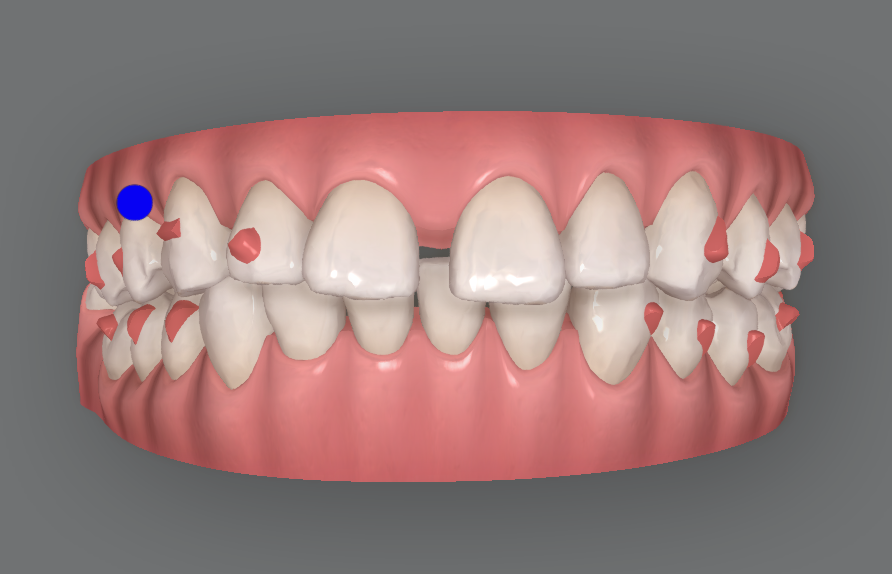
A clinical aligner simulation is a technical planning tool used by orthodontists to design how aligners apply pressure to teeth over time. It shows how teeth are positioned within the aligners, rather than how they will ultimately look once treatment is complete.
Why does the simulation include overcorrection?
Some teeth are more challenging to move and require additional pressure to reach their ideal position. To account for this, orthodontists intentionally plan overcorrection within the simulation.
Overcorrection allows aligners to deliver the necessary force to guide teeth fully into the desired position. It is a normal, purposeful part of aligner treatment and reflects how the aligners are engineered, not the intended final appearance.
Does overcorrection mean teeth are meant to end up that way?
No. The overcorrected positions shown in the simulation are not the final goal. They simply represent how the aligners are shaped to apply pressure. The true objective is the ideal tooth position achieved clinically, not the overcorrected position seen digitally.
Why can the simulation look concerning to patients?
Without clinical context, the simulation may give the impression that:
Teeth are being moved too far
The bite looks incorrect
The final result appears unfinished
This can understandably create doubt or anxiety, even though the treatment is progressing exactly as planned.
Why doesn’t the final image show the true end result?
The final image in a clinical aligner simulation corresponds to the shape of the last aligner, not the completed biological result. It does not account for:
Clinical finishing
Refinements
Bite adjustment
Final aesthetic assessment
As a result, the image may not reflect how the teeth will look or function at the end of treatment.
Could seeing the simulation affect patient confidence?
Yes. When patients view a technical simulation as a preview of their final smile, it can lead to unnecessary uncertainty about the outcome or concern when refinements are needed. These steps are a normal and expected part of high-quality orthodontic care.
Is the clinical aligner simulation a guarantee of results?
No. The simulation is designed for force planning and biomechanics, not as a visual promise. The final outcome is determined by clinical evaluation, function, stability, and aesthetics, not by a digital model alone.
How do we assess the true final result?
Treatment completion is based on:
Clinical examination
Bite function
Tooth alignment and stability
Aesthetic harmony
Finishing and refinement stages
These factors can only be fully assessed in person.
Does not sharing the simulation mean a lack of transparency?
Not at all. We believe transparency means clear communication and realistic expectations, not sharing technical images that can be misleading without professional interpretation. We focus on explaining treatment goals, progress, and outcomes in a way that is clear and reassuring.
In summary
The clinical aligner simulation intentionally includes overcorrection and an end image based on aligner shape rather than the true clinical result. Sharing it without context can create unnecessary confusion or uncertainty about treatment outcomes. For this reason, it is used as a clinical tool to support expert care, not as a patient-facing preview.

.jpg)